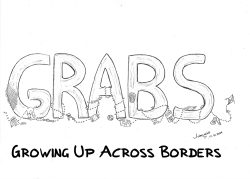
An English description and transcription of the content of this comics-based essay is available to download here

Une description et une transcription en français du contenu de cet essai-BD est disponible de télécharger ici

Una descripción y transcripción en español del contenido de este ensayo-historieta se puede descargar acá

© 2025 Juanchila

Cover Panel text description and transcription

© 2025 Juanchila

Panel 0 – Introduction text description and transcription

© 2025 Juanchila

Panel 1 – Questions of positionality. Text description and transcription

© 2025 Juanchila

Panel 2 – Mi’kma’ki. Text description and transcription

© 2025 Juanchila

Panel 3 – Getting there. Text description and transcription

© 2025 Juanchila

Panel 4 – Kaleidoscopes. Text description and transcription

© 2025 Juanchila

Panel 5 – Presenting GRABS & PhD at Saint Mary’s. Text description and transcription

© 2025 Juanchila

Panel 6 – Encounters. Text description and transcription

© 2025 Juanchila

Panel 7 – Pier 21. Text description and transcription

© 2025 Juanchila

Panel 8 – Africville. Text description and transcription

© 2025 Juanchila

Panel 9 – Wolfville, Grand-Pré… Acadia. Text description and transcription

© 2025 Juanchila

Panel 10 – Wela’lin, K’jipuktuk Nmul’tes. Text description and transcription

© 2025 Juanchila

Panel 11 – References, Credits & Thanks. Text description and transcription


Comics-based essay content text descriptions and transcriptions in English

Note for readers:

  1. Panels and cells for this comics-based essay can be read in any order and direction.
  2. The description and transcription of the content for each of panels of the comics-based essay follows the typical Z direction of Western comics (i.e., from top to bottom, and from left to right).
  3. For each panel, always following the Z direction of reading, I have indicated whenever the text is extracted from yellow boxes, the white dialogue/contextual bubbles/boxes, and/or the arrow references within the images themselves.
  4. All references to sources for drawings and pictures and maps in Panels 0 through to 10 are included in the last panel, Panel 11.

Cover

Fieldwork and scoping visit to K’jipuktuk-Halifax, Nova Scotia, Canada

A comics-based essay

by Juanchila, Juan Manuel Moreno

November 2025

Plurilingual text on sidewalk within main illustration:

English: lived experiences

Français (French): connaissances knowledge

Español (Spanish): historias stories

Ελληνικά (Greek): μετανάστες (metanástes) migrants

journey, route (rihla) رحلة : (Arab, earabiun) عربي

home, house (kor) کور : (Pashto, pakhto) پښتو

Runasimi (Quechua): ayllu community

ᓀᐦᐃᔭᐃᐧ (nêhiyawi-, cri): ᑭᐢᑭᓯᐃᐧᐣ (kiskisiwin) memory

Zulú: umhlaba land

বাংলা (Bānlā, Bengal): সমুদ্র (Samudra) see

Part of Mi’kma’ki

matéman

Turtle says: “No thanks, I actually don’t like it”

Panel 0 – Intro

INTRODUCTION

This comics-based essay forms part of Growing Up Across Borders (GRABS), a five-year research project financed by the European Research Council that examines the experiences of young people growing up in situations of forced migration and (im)mobility across borders. The project aims to better understand how lived experiences of violence, displacement, migration and borders impact young people’s lives and transition to adulthood, crossing geographical mobility with mobility across the life course.

The essay is both a report and a methodological exploration produced during my fieldwork and scoping visit to K’jipuktuk-Halifax, Nova Scotia, Canada, between 18 July and 4 August 2025.

K’jipuktuk, which means Great Harbour in Mi’kmaw language, is located in Mi’kma’ki, the ancestral and unceded territory of the Mi’kmaq peoples.

Alongside contextual descriptions and facts about the places I visited, I have included historical maps, academic references, artworks and visuals. The whole document follows a chronological narrative of my research activities, personal field observations, and encounters with local actors and community-based organisations. As a methodological exploration, the essay draws from the emerging field of practice of Comics-based research (CBR) (Kuttner et al., 2021). CBR and the use of comics in the social sciences have a long, rich and evolving history (Flowers 2017; Worcester 2017; McNicol, 2019; Rainford, 2021).

Amongst the affordances of the comics form that I make use in this essay, there are: the use of sequence and simultaneity (that allow me to depict linear narratives and events, while also representing some complex non-linear meaning-making and reflections of my visit); multi-modality (where I have combined text and images with deliberate choices in the colour, size, and positioning of characters, objects, gutters, as well as the inclusion of other visual elements such as photos and maps. All of this helps me capture and convey affective experiences such as joy, confusion, or the tensions arising from conflicting causes and/or realities within close spatial relationships); and voice and style (where I have made use first of my comic ‘matéman’, to reflect on my positionality and privileges, and second of Mi’kmaw and other Indigenous place names and symbolisms, to acknowledge the original peoples of these and other lands, their presence and their ongoing struggles).

With their affordances, comics also bring many challenges (from issues of confidence and the ability to draw, to the dangers of simplification and misrepresentation of complex social concepts and/or cultural mores, through the ethics of informed consent, accountability and credit) and potential pitfalls (are comics-based approaches about meaningful engagement or merely for easier dissemination of information?) (see Kuttner et al., 2021). While I take hold of and acknowledge these issues, they merit a proper reflection that is beyond the remits of this essay (something I am hoping to address elsewhere throughout the course of my doctoral research).

Some of the illustrations and drawings included in this comics-based essay were produced most recently as part of my research within the GRABS project (such as conference presentations and artworks for the project), while others were drafted during the fieldwork visit itself.

To make the essay more accessible to the reader, I used an almost chronological linear-sequence of my field visit,  and colour-coded each of the story panels according to a specific theme. There are a total of five coloured themes:  White , which is used for the introduction in this very page;  Red , which is centred around my positionality as a researcher and a visitor (Panel 1 – Questions of Positionality), acknowledging Mi’kma’ki territory and the Mi’kmaq Peoples (Panel 2 – Mi’kma’ki), and recognising and embracing my privileges and responsibilities (Panel 3 – Getting There);  Yellow , which is focused on my research work (Panel 5 – Presenting GRABS & PhD at Saint Mary’s, and Panel 6 – Encounters), and my very first impressions and observations from walking the city (Panel 4 – Kaleidoscopes);  Black , which touches on three distinct and important sites of K’jipuktuk-Halifax’s more recent and complex history such as the latest European settler-colonial migration throughout most of 20th century (Panel 7 – Pier 21), the marginalisation, neglect and ultimately forced displacement of the Black community of Campbell Road, on the shores of Bedford Basin, during the 1960s (Panel 8 – Africville), and that of the Great Deportation of the Acadians in mid-18th century (Panel 9 – Wolfville, Grand-Pré … Acadia).

The colours I have used are taken from the Mi’kmaw Star and represent harmony and unit. Each colour relates to one of the four directions: White for North, land of ice and snow, animals that are white; Yellow for East, land of the rising sun; Mi’kmaq are ‘people of the dawn’; Red for South, the further south you travel in Turtle Island, the warmer it becomes; and Black for West, where the sun travels to give us night.

The last panel in Orange is in gratitude to the place and its people (Panel 10 – Wela’lin, K’jipuktuk, Nmu’ltes, thank you K’jipuktuk, see you soon). Panel 11 includes references and acknowledgements to the various people I met, helped me and inspired this comic.

That’s it ! I hope you enjoy the comic

Bye now

Juanchila

Bergerac, France, 17.11.2025

Panel 1 – A question of positionality

Top of panel

Text in yellow boxes

In late July, I travelled to K’jipuktuk-Halifax, in Eastern Canada for a two-week fieldwork and scoping visit.

Text in white bubbles/boxes

About the turtle:

Turtle Island’ is the name used by some Indigenous Peoples in what today is known as North America, mainly by Indigenous Peoples from the Northeastern parts of the land. My Drawing is inspired by some of the  indigenous creation stories and oral histories where the turtle is a symbol of earth and life.

Mate (pronounced maté in Spanish, and Ka‘ay or Caá in Avá-Guaraní ) is a traditional herbal infusion originary from South America. The leaves of the Ilex paraguariensis (the yerba maté tree) were originally consumed by the Káingang Peoples (indigenous to today’s South Brazil), and later by the Avá Peoples (commonly known as Guaraní, and indigenous to today’s South Brazil, Paraguay, Uruguay, Northeastern Argentina, and Eastern Bolivia). matéman is a cartoon I created a while ago, and it is how I got into comics. I drink maté everyday, it is part of my research process.

Text within image

[Dialogues/bubbles]

matéman: !?

turtle: It’s just a question of positionality (text is flipped up-side down)

[Text on map and indicative arrows]

Freehand drawn,

non-AI, inaccurate,

and not at scale

world map

matéman

South

Córdoba

where I was born

Hênîa-Kâmîare

(Comechingones)

Peoples’

ancestral land

Káingang and

Avá (Guaraní)

Peoples

Paris

K’jipuktuk-Halifax

mate

Bottom of panel

Text in yellow boxes

These two maps show a South-centred world map (above), and a flipped North-centred close up of what today is known as Nova Scotia. Both of these maps had the intention to (1) decentre and discomfort the viewers, (2) introduce some basic land acknowledgements, and (3) position myself and my research. I had originally freehand drawn both maps for the IMISCOE 2025 Annual Conference ‘Decentering migration studies’.

Text in white bubbles/boxes

K’jipuktuk-Halifax is part of Mi’kma’ki, the ancestral land where the Mi’kmaq have lived  for over 11,000 years. Today, K’jipuktuk – Halifax is the capital of what is known as the province of Nova Scotia which, before being colonised, formed part of Mi’kma’ki, the ancestral and unceded territory of the Mi’kmaq.  Located within the Northeastern Woodlands, Mi’kma’ki territory extended across all 4 provinces of today’s Atlantic Canada (Nova Scotia, New Brunswick, Prince Edward Island, and Newfoundland), the Gaspé Peninsula, and parts of the state of Maine, in today’s United States. Mi’kmaq Peoples include several Indigenous First Nations. K’jipuktuk means ‘Great Harbour’ in Mi’kmaw.

Text within image

[Text on map and indicative arrows]

North

(somewhere

up there)

New Brunswick

Prince Edward Island

Inaccurate Map not at Scale

Still Freehand drawn and non-AI generated

K’jipuktuk-Halifax, Nova Scotia

Flipped,

North-centred

closed-up map of

K’jipuktuk-Halifax

matéman

Panel 2 – Mi’kma’ki

Top of panel

Text in yellow boxes

K’jipuktuk (Halifax) and what is today known as the province of Nova Scotia form part of Mi’kma’ki, the ancestral and unceded territory where the Mi’kmaq Peoples lived for more than 11,000 years. Located within the Northeastern Woodlands, Mi’kma’ki territory extended across all 4 provinces of today’s Atlantic Canada (Nova Scotia, New Brunswick, Prince Edward Island, and Newfoundland), the Gaspé Peninsula, and parts of the state of Maine, in today’s United States.

Text within image

[Text on map]

Kespe’k

Ktaqmkuk

Siknikt

Epekwitk aq Piktuk

Unama’kik

Kespukwitk

Sipekne’katik

Eskikewa’kik

Bottom of panel

Text in yellow boxes

Prior to the geopolitical boundaries and foreign place names that followed the 15th and 16th century incursions and exploration voyages, and 17th century settler colonization, the Mi’kmaq recognised seven ‘districts, still recognised today. An eight district, Ktaqmkuk (Newfoundland) was added in 1860. While demarcations and descriptions vary in the literature, each of the eight district boundaries of Mi’kma’ki reflect the Mi’kmaq knowledge of the area’s resources. Petrogliphs, legends, oral histories, dances and songs reflect the lands’ varying geological formations, river streams and drainage systems, and climatic shifts from deglaciation and reglatiation. Unlike today’s geopolitical borders, Mi’kma’ki district boundaries were “flexible and permeable, reflecting changing conditions and the needs of people in each area”(Sable & Francis, 2018: p.21).

Kespe’k (”end of land”) is comprised of the Saint John River Valley and the Appalachian Mountain Range of northern New Brunswick and the Gaspé area of Quebec. Epekwitk aq Piktuk (Prince Edward Island, “cradled above water” and Pictou “explosion place”) is comprised of PEI the lowland area along the Northumberland Strait, sperated from neighbouring districts by the Cobequid Highlands and the Pictou and Antigonish Highlands. Sipekne’katik/Sikipne’katik (Shubenacadie, “area of wild potato/turnip”) is comprised of the Shubenacadie District and the Minas Basin Coast. Kespukwitk (”end of flow”) includes the area west of the La Have River to Yarmouth/Cape Sable in South/southwestern Nova Scotia. Unama’kik (a variation of the word Mi’kma’kik, meaning “Mi’kmaw territory”) Cape Breton Island. Siknikt (”drainage area”) includes the Miramichi River and the Acadian Coast and Bay of Fundy Region. Eskikewa’kik (translation uncertain at this time, some suggest “skin dressers”) comprised of the portion of Atlantic Coastal Region from the western portion of Nova Scotia west of Sheet Harbour to Canso. Ktaqmkuk (”across the waves/water”) Newfoundland.

Panel 3 – Getting there

Top, Centre and Bottom of panel

Text in yellow boxes

[Top left] I work at the Centre for Sociological and Political Research in Paris (CRESPPA), but I live in Bergerac, which is somewhat south-east of Bordeaux. So, to get there I first took a train to Bordeaux, then a bus to the airport in Merignac, then a plane to Amsterdam, and then another plane to K’jipuktuk. For the two plane rides, that’s about 988 kg of CO2 (according to the https://agirpourlatransition.ademe.fr/ footprint calculator)… to which I would have to add the train and bus journeys: roughly another 2.53 kg of CO2. Important for me to reflect on these things… I am, after all, working on a project that deals with aspects of forced (im)mobility, displacement, and extraction… Travelling somewhere by plane is both a process of movement (of peoples and things) and extraction (of natural resources, of clean air… and so many other things that escape my reflection right now).

[Middle right] I often add a little text about my positionality when posting blogposts. That text always includes a few lines on how lucky and privileged I am of having been born a man in South America, to European-descendant parents, and holding an EU passport which makes everything easier for travelling, working, and studying across the world. And travelling to K’jipuktuk-Halifax was no exception. I didn’t require a visa, of the EU passport, so by just paying about CAD $9, filling in a form with questions, and after a few minutes wait, I got an email with a confirmation of my approved Canadian ‘electronic travel authorisation’ or eTA.

[Bottom centre] I cherish this wonderful mobility, yet I cannot take it for granted. The images around the eTA form and passport drawing depict some of the thoughts that emerged in my mind on those who cannot move/travel/cross borders this easy. 

Text within image

[Dialogues/bubbles & indicative arrows]

Border Force Boat; officer on boat hands up and says: No!

Small Boat with lots of human beings onboard

Documenoid: [walking person with torso made up of stack of papers and documents. Some papers fly away and read: ‘bank statements’, ‘visa app.’ and ‘birth certificate’]

A ‘Beast’ train carrying lots of human beings on its roof

‘ICE’-cold border agent, in front of barbed wire and fenced border, hand up and says: No! to groups of people arriving by walk through desert.

[Text on centre of image, next to eTA application and Passport drawings]

Government of Canada electronic travel authorization (eTA) status:

eTA status: approved / eta Number: J###### / eTA expiry date: 2030-MM-DD / Passport number: YB###### / Country/Territory of issue: ITA (Italy) / Issue date: YYYY-MM-DD / Name and Surnmae: Juan Manuel MORENO / eTA document status : this message confirms  that your app——– has been approved. An eTA is valid — to five years or until passport expires.

Passport: Unione Europea: Republica Italiana: Passaporto

Panel 4 – Kaleidoscopes

Top of panel

Text in yellow boxes

[Top left] I arrived over the weekend, and so I spent my first days in K’jipuktuk-Halifax exploring its variegated sidewalks and peoples. 

[Top right] I had arrived during the Pride Parade, I walked past destitute people begging next to ancestral land acknowledgements, and I visited the Central Library…

Text in white bubbles/boxes

Spring Garden Road

Pride Parade

Text within image

[Dialogues/bubbles & Indicative arrows]

Dollorama

Lord Nelson hotel & suites

Tim Hortons café

eastlink

Halifax Central Library

Storytelling

National seating and mobility [text and logo on wheelchair]

Happy Pride [text on fire truck]

All Hearts Need Homes [text on cardboard sign held by pride parade participant

Mi’kmaw Star

Bottom of panel

Text in yellow boxes

[Bottom left] I met Jill, a Mi’kmaw friend; I saw ‘Halifax’, ‘Scottish-Canadian’, and ‘Acadian’ tourist shops by the seafront; I came across beautiful and evocatique murals and contemporary artworks by Indigenous and settler peoples.

[Bottom right] It was trully a kaleidoscope of ever changing colours, accents, causes and views.

Text in white bubbles/boxes

Boardwalk

Text within image

Halifax Authentic T-Shirts

The Tastes of Nova Scotia: Scottish Canadian Foods, Goods, Gifts

Acadia: Souvenirs, Cadeaux, Tout ce qu’il faut !

Sitamuk : K’jipuktuk Cultural Post [on shop cabin]

Sitamuk : K’jipuktuk Cultural Post : L’nuk Economic Opportunity [on sign next to shop cabin]

The Way Things Are [three lamp posts sculpture, see references]

[Dialogues/bubbles & Indicative arrows]

-Tourist says to Sitamuk shop worker: “Hi there! Do you sell ‘Halifax’ T-shirts? You know, the authentic ones?”

-Sitamuk shop worker reacts: ?!!

Panel 5 – Presenting GRABS & PhD at Saint Mary’s

Top of panel

[Top left scene]

Text in white bubbles/boxes

Wednesday 22 July Saint Mary’s University Room MN519 … 14h00

Main room’s projector: “No signal”

Text within image

-IT Services over the phone to professor: “We are sorry for the inconvenience, but your SMU password needs to be updated. To update your password, connect to the internet.”

-professor’s computer: “No internet”

-professor’s reaction: “!?”

-matéman character: “…?”

-matéman character’s computer: “No.”

-participants’ computers: “No”, “No”

Centre of table: Pizza box

[Top right scene]

Text in white bubbles/boxes

Wednesday 22 July Saint Mary’s University Room MN519 … 15h00

Main room’s projector: “No signal”

Text within image

-matéman character: “GRABS”

-matéman character’s computer: “GRABS”

-participants’ and professors’ computers: “GRABS”

Centre of table: Pizza box

Bottom of panel

Text in yellow boxes

My presentation was delayed by about one hour as there was no internet connection in the room. Despite the delay, six people stayed (four were in the room, and two online). The presentation included an introduction to the GRABS project – its rationale, participatory methodological approaches, and the case study locations of the research. It was also an opportunity for me to gain critical feedback* on my PhD project ideas and fieldwork activities.*Critical feedback is another term used for ‘amicably been ‘grilled’ by tough questions’.

Text within image

[Text on freehand drawn world map]

GRABS Project: Where?

United Kingdom

Canada

France

Greece

South Africa

South

Inaccurate freehand drawn map with colonial borders [vertical text on right-hand margin of panel]

[Text appearing on MS PowerPoint slides]

Slide 1: GRABS: PhD research concept and full working title: Recentring youn people on the move’s lived experiences of forced migration: A decolonial, intersectional, and creative participatory study of the K’jipuktuk-Halifax context. [with “On the move: the troubling categories of (im)mobility” illustration within slide]

Slide 2: Exploring a possible mixed method – Comic-based & Photovoice approaches

Slide 3: Intersectional Barriers, and Micro & Macro Aggressions [with 4 drawings of comics within it]

Panel 6 – Encounters

Top of panel

Text in yellow boxes

[Top right] On Saturday 26 July, I was invited to dinner by the Prof Tastsoglou (Evie), where over pizzas, salad and wine, I met with various friends, colleagues and former students of evie’s. Over the following days I would meet with some of them, and others, in a more formal setting to share about the GRABS project, my PhD, and explore possibilities for collaboration.

Text within image

[Indicative arrows on dinner table]

Wine

Alfajores de maïcena

Middle of panel

Text in yellow boxes

[Middle top] Some of these people and organisations and community grassroots initiatives I met and chatted for a long time, others I saw them only briefly, and yet others I hope to connect with them soon.

[Middle bottom] After each of my meetings, immediately or a few days after, I would sit at the desk at my Dalhousie Residences room, and draft, attach, copy and paste, and then, after a few seconds of hovering over the button, click send ‘thank yous’ and ‘information’ and ‘follow up’ emails to everyone.

Text within image

[Text next to organisational and institutional logos]

The Y, Halifax Refugee Clinic, Avalon, iSANS, Rainbow Refugee Association of Nova Scotia, Welcoming Wheels, Wije’winen Mi’kmaw Nativew Friendship Centre, Saint Mary’s University, Dalhousie University

[text next to matéman character typing emails to the Y and to HRC teams]

[email to the Y team]

from: juan-manuel.moreno@univ

to: the Y team

subject: thank you + docs

Dear Y team,

I wanted to thank you for the time last Tues|

[email to the HRC team]

from: juan-manuel.moreno@

to: the HRC team

subject: thank you + info

Dear HRC team,

I was very grateful to meet the team yesterday and discuss about the GRABS project.

As promised, I am sen|

hrrrrhrrr hurrrrr maté drinking sound

draft draft draft

tap tap tap

click copy tap

draft draft draft

click past tap

click attach revise

click attach revise

tap tap click

click click send

Bottom of panel

Text in yellow boxes

[Bottom left] Most days I would note down my observations on my agenda (notes on feelings, events, things, and places). Just a few keywords and lines. I would then, with much effort, type them out into the computer.

Bottom centre] And during one of those days, I wanted maté but most Latin foods shops were closed, then I remembered that some people also drink maté in the Middle East … Migration made my breakfast.

Text within image

[Typed observations on word]

Observations

Monday 28 July – Morning -_-

Why, why do I not type my notes directly into the computer?! Oh! Gods, legends and elements! The misgivings of freehand, non-AI writing and drawing… creativity, reflexion, thinking … it all takes time. But it’s worth it.

[Text within Agenda drawing]

July 2025

21 Mon meet Evie -> Met with Prof Evie she’s cool

22 Tue SMU admin

23 Wed GRABS PhD presentation -> @SMU MN519 14h00 · it was delayed · it went OK.

24 Thu

25 Fri Africville -> visited Africville ! Bus + walk. Difficult to find. Emotionally charged day. Beautiful, sad, want to go back. -> Remember to email and thank Bernice.

[Indicative arrows and other drawings]

Brokken pen

Yerbamate elaborada. Syrian yerba maté

Panel 7 – Pier 21

Top of panel

[Top Left]

Text in yellow boxes

Pier 21, port of entry, point of transit, place of destination, departure, and sometimes… return.

Between 1928 and 1971, Pier 21 functioned as one of the main immigration ports of entry to what today is Canada, along with ports in Quebec City and Victoria in British Columbia. But Pier 21 was particular for its deep waters for larger ships. Also, it didn’t freeze during winter, allowing it to remain open throughout the year. Around 1.5 million people came through Pier 21, especially during World War II and during the postwar years. I learn in the museum that prior to Pier 21, Pier 2 was used as ‘immigration port’, at the north end of K’jipuktuk-Halifax coast. However, bigger ocean liners and larger migrant numbers led to the construction of Pier 21 – which was delayed by both WWI and the Halifax Explosion of 1917.

Following its closure as a seaport immigration facility in 1971, on April 1st the Immigration Office moved to the Canada Manpower Centre at Sir John Thompson Building on Harvey St. From there, immigration officers would make their way down to Pier 21 to process the arrival of the ocassional ship carrying newcomers.

After that, Pier 21 had many uses: it housed the NS Nautical Institute, it served as an artist workshop, and it was used by customs authorities and Halifax port police. In 1997, it was designated a National Historic Site as the last surviving seaport immigration facility in Canada. Today, apart from being a museum, the former medical wing houses the NS College of Art and Design, and opposite annex buildings are today used by the Garrison brewing  company,  retail shops, as well as artists’ and architects’ studios, and        cultural organisations offices.

[Top Right]

Text in white bubbles/boxes

Some facts and figures about Pier 21

Opened: March 8, 1928

Closed: March 31, 1971

First ship: SS Nieuw Amsterdam on January 25, 1929

Last ship: SS Cristoforo Colombo on 30 March, 1971

Pier 21 included: immigration processing facilities, medical and detention quarters, customs and police, charity organisations facilities. It was designed to be integrated to the railway network from where migrant families would then depart to different provinces and territories across Canada.

Total estimated number of people arriving through Pier 21 in search of a new, better life (between 1928-1971): 1.5 million

Text within image

[On Pier 21 building]: Canadian Museum of Immigration at Pier 21 . Musée Canadien de l’immigration du Quai 21

Bottom of panel

Text in yellow boxes

On my very last day in K’jipuktuk-Halifax, I visited the Farmers’ Market at Pier 22. As I sat outside to eat an arepa, I looked in the direction of Pier 21, its adjacent walls sprayed with enormous and gorgeous graffities with Mi’kmaw and Black community motives, and sea animals, and music, and various fantasized cityscapes. From behind Pier 21,  the gigantic, city-size silhouette of the ‘Island Princess’ an ocean liner cruise carrying tourists from other places in Atlantic Canada. I tried to imagine the last ship carrying newcomers, the SS Cristoro Colombo, then my mind took me to the Dutch ‘kists’, large wooden crates packed with treasures from home. Then my migrantising mind and heart took me to December 25, 2002, when I was leaving Córdoba, friends and neighbourhood, for Canarias with my mum and brothers, each one of us carrying two large suitcases amounting way more than the 23kg permitted on the plane. It is interesting… How a previously unknown place, its changes, its  layers of history, memories and events – passed  on in written and oral and visual and imagined and felt forms – can evocate personal, intimate lived experiences of passage.

Text within image

  • Dialogues/bubbles

[Text on image and indicative arrows]

Cristoforo Colombo [ship]

Canadian National Railway Westward, Northward, Southward Canada [Drawing of train]

Dutch ‘Kist’ Packed with treasures from home [Picture of ‘Kist’ from Pier 21 museum]

Panel 8 – Africville

Top and bottom of panel

Text in yellow boxes

Africville began where the pavement ended

Africville was a Black community located on the shores of the Bedford Basin, on the north end of K’jipuktuk-Halifax. With a population that reached around 400 people at its peak, many of its residents traced back their roots to Black loyalists arriving to Nova Scotia in the 1700s, and others to Black Refugees escaping slavery from the United States during the War of 1812.

The community prospered for over 150 years, between 1848 (when the first deeds of land are registered) and 1969 (when the city of Halifax authorities finalised with their formal removal and relocation of Africville’s residents – which is another way of articulating the process of forcibly displacing people from their homes … in rubbish trucks). Behind the razing and demolition of Africville’s homes, there were the extension of the railway network and the highway interchange that today serves the A. Murray Mackay bridge.

Africville had prospered in spite of the neglect of city officials. Eventhough residents paid their taxes, basic public services (clean running water, electricity, sewers, paved roads, garbage collection) were minimum or non-existent. Instead, Africville became the site of a slaughter house, a hospital for infectious diseases, and the city dump.

In 2002, Africville was declared a National Historic Site of Canada. In 2010, the City of Halifax offered an official apology to     former residents, including financial compensation

and the rebuilding of the community’s church.

Text within image

[Text next to indicative arrows]

  1. Murray MacKay Bridge

Seaview United Baptist Church (Replica)

View of Bedford Basin

Railway

[Text next to and on Seaview Memorial]

Seaview Memorial Park

Land Deeded

1848-1969

Dedicated in loving memory of

the first black settlers and all

former residents of the community

of campbell road, Africville and all

members of the Seaview United

Baptist church

First Black settlers

William Brown

John Brown Thomas Brown

To lose your wealth is much

To lose your health is more

To lose your life is such a loss

That nothing can restore

Erected 1988

Panel 9 – Wolfville, Grand-Pré … Acadia

Top and bottom of panel

Text in yellow boxes

I also visited, though briefly, Wolfville and the Grand-Pré on the Minas Basin, East and North of the Bay of Fundy. This was thanks to Evie and Evangelos. These places have a lot of history and resonate with the GRABS project. Apart from its famous tidal changes, the place is home to Acadia University, and the Al Wittle Theatre / Acadia Cinema Cooperative where many creative community events take place.

Wolfville, Grand-Pré (where Acadian farmers successfully enclosed estuarine salt marshes with dykes to farm fruits and vegetables), and other settlements around the Bay of Fundy and the Annapolis valley are border places between former French and British colonial settlements, and where Mi’kmaq First Nations were enlisted by each side to fight the other.

It was around these places too where the first forced removal and expulsion of the Acadian community took place. Between 1755 and 1764 – a period known as the expulsion or Great Deportation of the Acadians – Great Britain forcibly removed and displaced around 11,500 people out of an estimated population of 14,100. Acadians were deported from the Canadian Maritime Provinces (Nova Scotia, New Brunswick, and Prince Edward Island) and parts of the State of Maine in the US. About 5,000 of those deported perished to disease, starvation or shipwrecks.

Text in white bubbles/boxes

[Top left picture]

Al Wittle Theatre Acadian Cinema Cooperative

[Top right comics]

Hide tide

Low tide. Algae

Bottom of panel

Text in within map

Map of Main Acadian settlements prior to the Great Deportation c. 1750

Text within map key

Acadian Population Acadienne 1750

Circles: Blue Acadians, Grey Other French, Pink/Red British

Circles are proportional to population of major settlements (thousands): Biggest 4000, medium big 2000, medium small 1000, smallest 500; one dot represents 25 people

Triangles: Blue French Fort, Pink/Red British Fort

Shaded: Blue French territory, Pink/Red British

Panel 10 – Wela’lin, K’jipuktuk Nmul’tes

Top and bottom of panel

Text in yellow boxes

In K’jipuktuk (Great Harbour) – Halifax, I visited places of old and present arrival, departure and settlement.

In the past, most times, these places were welcoming ports for those escaping atrocities or in search of a better life. Other times, they were cold and administrative sorting points of transit, detention, quarantine or even return. They also became places of violent disputes, conflicts, and expulsions. And sometimes, some places were ignored, disregarded and neglected by some, while they became  bustling communities for others.

In a more distant past, and yet omnipresent ‘here and now’, all these places were sites of colonial seizure, raze, expropriation,  and displacement in the name of settlement and civilization then, in the name of progress and ‘urban renewal’ today.

Today these places  might have changed into museums, cruise terminals, artists workshops, farmers markets, memorials, and cultural and natural heritage sites. But they still are, above all, sites of passage and resistance.

Text in white bubbles/boxes

Text within image

[Indicative arrows]

Mi’kmaw Star

Nova Scotia within unceded Mi’kma’ki territory

Close-up map of downtown K’jipuktuk-halifax with Punamu’kwtijk-Dartmouth across the bay

[Text within OS Map]

K’jipuktuk Great Harbour – Halifax 

Punamu’kwtijk At the salmon place – Dartmouth

Panel 11 – References, Credits & Thanks

White box. Top left

PANEL 0 – Introduction. Sources:

Flowers (2017) Experimenting with comics making as inquiry; Worcester (2017) Comics, comics studies, and political science; McNicol (2019) Using participant-created comics as a research method; Kuttner et al. (2021). Comics-based research: The affordances of comics for research across disciplines; Rainford (2021) A critical reflection on the dual use of comic-based approaches. Information on Mi’kmaw colours and directions is from a talk by Mi’kmaw Hereditary Chief, Elder and Knowledge Keeper Stephen Augustine (2017) Creation Story https://www.youtube.com/watch?v=b_MAh824MKU

Red box. Middle left

PANEL 1 – Questions of Positionality. Sources:

Teuton (2012). Cherokee Stories of the Turtle Island Liars’ Club; Kimmerer (2013). Braiding sweetgrass: Indigenous wisdom, scientific knowledge and the teachings of plants; Navajas (2013). Caá porã: el espíritu de la yerba mate: una historia del Plata; Robinson & Filice (2018). Turtle Island, in the Canadian Encyclopedia; Sable & Francies (2018). The Language of this Land, Mi’kma’ki; Sosnowski (2021). Los comechingones en Córdoba. Una mirada histórica sobre los procesos de invisibilización indígena (siglos XVI-XXI); Le Bret (2024). Mapping Mate from Colonial to Consumer Society;

PANEL 2 – Mi’kma’ki. Sources:

Map: Government of Canada (2025) Map of the Districts of Mi’kma’ki (Kjipuktuk aq Mi’kma’ki). Fort Anne National Historic Site & Fortress Halifax Exhibit, Parks Canada, https://parks.canada.ca/lhn-nhs/ns/fortanne/culture/autochtone-indigenous/carte-mikmaki-map

Sable & Francis (2018) The Language of this Land, Mi’kma’ki, pp.19-22, Figures 1 and 2.; Mi’kmaw Place Names Digital Atlas, https://placenames.mapdev.ca/ ; Mi’kmawey Debert Cultural Centre, https://www.mikmaweydebert.ca/

PANEL 3 – Getting there. Sources:

Foot Print calculator used: ADEME (2025); https://agirpourlatransition.ademe.fr/ ; Canada Electronic Travel Authorisation (eTA), https://www.canada.ca/en/immigration-refugees-citizenship/services/visit-canada/eta/apply.html

Yellow box. Middle right

PANEL 4. Kaleidoscopes. Sources:

 “The Way Things Are”lamps illustration based on the artwork by Chris Hanson & Hendrika Sonnenberg (2012). The composite located in the K’jipuktuk waterfront shows 3 unique steel sculptures’ “take the form of functioning street lamps doing some particularly ‘human’ things. Got Drunk, Feel Down, Fountain: The diptych Got Drunk, Fell Down features a fallen light standard, while a second lamp seems to look on with concern; Fountain illustrates a biological need not frequently associated with keeping our streets illuminated after dark. This playful installation points to mischievous behaviours often witnessed in our cities and waterfronts.” Text taken from the artwork notice board at the waterfront.

Sitamuk K’jipuktuk Cultural Post is a storefront place run by the Mi’kmaw Native Friendship Centre with authentically-made Mi’kmaw and Indigenous arts, crafts, and merchandise. It provides new economic development opportunities for Indigenous communities—not only in providing a hub to connect their creations to a wider audience, but using proceeds to help fund Indigenous programs and services for K’jipuktuk-Halifax. Sitamuk (Sit-ah-mook) means “on the water”. Instragram: @sitamuk

I want to express my gratitude to Mi’kmaw artist and friend, Jill Robinson, for her advice and information which helped and inspired part of this panel and my learning and explorations of K’jipuktuk. Her work can be found on Instagram: @spiritwaybeadwork and @_jillrobinson Wela’lin, Jill. Nmu’ltes!

PANEL 5 – GRABS & PhD Presentation at Saint Mary’s University. Sources:

Growing Up Across Borders (GRABS) project, and my PhD research, please visit: https://erc-grabs.univ-paris8.fr

I would like to thank Sarah Delorme, Charis Gervase, Douglas Mutch, and María José Yax-Frazer for having attended my presentation, giving me great feedback, and asking important questions. Thanks to Evie Tastsoglou for organising this.

PANEL 6 – Encounters. Sources:

Organisations’ illustrated logos credits (in alphabetical order, all errors and mistakes are mine alone):

Avalon  https://avaloncentre.ca/

Dalhousie University https://www.dal.ca

Halifax Refugee Services  https://halifaxrefugeeclinic.org/

isans Immigration Services Association of Nova Scotia  https://isans.ca/

Mi’kmaw Native Friendship Centre https://www.mymnfc.com/

Rainbow Refugee Association of Nova Scotia https://www.rainbowrefugeens.com

Saint Mary’s University https://www.smu.ca

Welcoming Wheels https://ecologyaction.ca/our-work/transportation/welcoming-wheels  

YMCA Greater Halifax & Dartmouth https://ymcahfx.ca

I would like to thank Julie Chamagne, Camila Reis, María José Yax-Frazer, Xanthi Petrinioti, Saja Al Zoubi, Shiva Nourpanah, Michael Campbell, Marlene Ramos, Miyuki Arai, Evangelos Milios, Athena Milios, and Eva Kazakou for welcoming me, sharing their time and their smiles, 🙂

Black box. Middle to bottom left

PANEL 7 – Pier 21. Sources:

Photo credit: Dutch Kist (large wooden crate), from the ‘Treasures from Home’ display at the Canadian Museum of Immigration at Pier 21, K’jipuktuk-Halifax, NS, Canada. Photo by Juan Manuel Moreno, July 2025.

Canadian Museum of Immigration at Pier 21. Immigration records, https://pier21.ca/

The Mail-Star (1971) ‘Immigration Office Moving’  in pages 1 & 8. Published on March 29, 1971, Volume 23, No. 73.

My thanks go to Jocelyn Bourque, Scotiabank Family History Centre Manager & Genealogical Researcher, at the Canadian Museum of Immigration at Pier 21 for providing me with a copy of this journal and information about the immigration office move and the last ships arriving to Pier 21.

PANEL 8 – Africville. Sources:

Grant & Campbell (2018) Africville; Peters & Williams (2009) Africville: Can’t stop now. Out of struggle comes strength (documentary); Africville Heritage Trust, https://africvillemuseum.org/

Full text from Seaview Memorial Park Sundial drawing:

Seaview Memorial Park Land deeded 1848-1969 dedicated in loving memory of the first Black settlers and all former residents of the community of Campbell Road, Africville and all members of the Seaview United Baptist Church first black settlers William Brown John Brown Thomas Brown To lose your wealth is much to lose your health is more to lose your life is such a loss that nothing can restore Erected 1988

I want to thank Bernice, former resident of Africville, for her sharing about Africville, her childhood experiences growing up in the community, and above all her kindness and patience. She invited me to the annual reunion which I could not attend. I hope to do so next time I’m in K’jipuktuk-Halifax.

PANEL 9 – Wolfville, Grand-Pré … Acadia. Sources:

Map credits: Acadian Population Acadienne 1750 extracted from the Canadian-American Centre, Univesity of Maine (nd) Acadian Deportation, Migration, and Resettlement: Explanatory maps of Saint Croix & Acadia: Acadian Deportation, Migration, and Resettlement,  https://umaine.edu/canam/acadian-deportation-migration-resettlement/

Photo credit : View of Al Wittle Theatre / Acadian Cinema Cooperative, Wolfville, NS, Canada. Photo by Juan Manuel Moreno, July 2025.

I want to thank Evie Tastsoglou and Evangelos Milios for driving me around and introducing me to these places.

Orange box. Middle to bottom right

PANEL 10 – Wela’lin, K’jipuktuk, Nmu’ltes. Sources:

Mi’kmaq Star. Wooden artwork located on Barrington St before Duke St (Nova Scotia Square), K’jipuktuk-Halifax, NS, Canada. Photo by Juan Manuel Moreno, July 2025.

Map credit: Halifax, Nova Scotia, Canada. Open Street Maps, Humanitarian Layer Tile Style. https://www.openstreetmap.org/

White box. Middle to bottom right

I want to thank specially Evie Tastsoglou, one of GRABS partners based at the Department of Sociology at Saint Mary’s University, for making all of these encounters possible. Amongst many other hats, Evie leads the GBV-MIG Canada Research Programme Violence Against Women Migrants and Refugees: Analyzing Causes and Effective Policy Response, https://www.smu.ca/gendernet/welcome.html

Finally, I would also like to thank my PhD supervisor, Jane Freedman, and my research team colleagues Glenda Santana de Andrade, Isabel Morrell, & Jessi Kume for their support and conversations, and for having trusted me the space to do illustrations and comics for the GRABS project.

White box. Bottom right

All cited websites & digital maps last browsed on 22.10.2025.

Unless otherwise stated, all photos & illustrations in PANELS 1-10 are by Juanchila for the GRABS project. (Copryright © & Creative Commons 2025 Juanchila,  Juan Manuel Moreno BY-NC-ND 4.0 International License; https://www.juanchila.com).

White box. Bottom centre

This work is part of the Growing Up Across Borders (GRABS) project, and was funded by the European Research Council (ERC):

ERC-GRABS Advanced Grant No. 101141171