

Comics, Photos and Podcasts from K’jipuktuk-Halifax, NS, Canada. Fieldwork visit report by Juan Manuel, July 2026
My PhD fieldwork research is being carried out in K’jipuktuk, today also known as Halifax, which is part of Mi’kma’ki, the ancestral and unceded territory where the Mi’kmaq Peoples have lived for over 11000 years. Today, K’jipuktuk-Halifax is the capital of what is known as the province of Nova Scotia. Before being colonised, Mi’kma’ki comprised a great part of the Northeastern Woodlands, extending across all 4 provinces of today’s Atlantic Canada (Nova Scotia, New Brunswick, Prince Edward Island, and Newfoundland), the Gaspé Peninsula, and parts of the state of Maine, in today’s United States. Mi’kmaq Peoples include several Indigenous First Nations. K’jipuktuk means ‘Great Harbour’ in Mi’kmaw language. I am thankful as a foreigner to be able to conduct research for my PhD and the GRABS project in these lands. Wela’lin.
On July 5th, exactly a month ago now, I returned from a three-month fieldwork stay in K’jipuktuk-Halifax, NS, Canada, where I conducted research for my PhD and the larger GRABS project.
This was my third research visit to K’jipuktuk, following from a two-week scoping visit in late July 2025 to meet and establish collaborations with local researchers and community organisations, and a one-month stay in February 2026 where I met and facilitated several focus group discussions (FGDs) with over 49 young people.
During this latest trip, which took part between April and early July 2026, I built on the work done through the FGDs to run a series of creative participatory workshops in comics and drawing for storytelling, photography and photovoice, and podcasts and soundscapes.
Of the 49 participants that I had met in February, a total of 18 young people agreed to join and participate across a total of seven creative participatory workshops (CPWs): 4 CPWs groups were facilitated in collaboration with the Halifax Refugee Clinic: 1x comics & drawing for storytelling, 1x podcasts & soundscapes, and 2x photography & photovoice. While at the Youth Outreach Team at the YMCA Centre for Immigrant Programmes, we ran 3 CPWs groups: 1x comics & drawing for storytelling, 1x podcasts & soundscapes, and 1x on photography and photovoice. Each CPW ran over a period of 6 weekly sessions lasting 3-hours each, with working groups varying between 3 to 8 youths each. For the last week of each workshop, we carried out a debrief session and mapping exercise to locate some of the lived experiences and stories that they had shared throughout the CPWs.
The youth who participated were aged 15-25 years old, were experiencing varying migrant situations, and came from diverse backgrounds and countries of origin, including: Afghanistan, Cameroon, Chad, Chile, Colombia, Cuba, Ethiopia, Ghana, Guatemala, India, Kenya, Nigeria, Palestine, Pakistan, Rwanda, South Sudan, Syria, Thailand, Turkmenistan and Uganda.
Some of the initial learning lessons and findings from this fieldwork with the young people were shared at the the Canadian Sociological Association (CSA) 2026 Annual Conference Harbours of Hope: Sociology in a Divided World, organised and hosted in partnership with Dalhousie University’s Department of Sociology and Social Anthropology, the conference took place between 1-13 June, in K’jipuktuk-Halifax, Nova Scotia, Canada. You can read more about it here.
Drawings & comics for storytelling CPWs
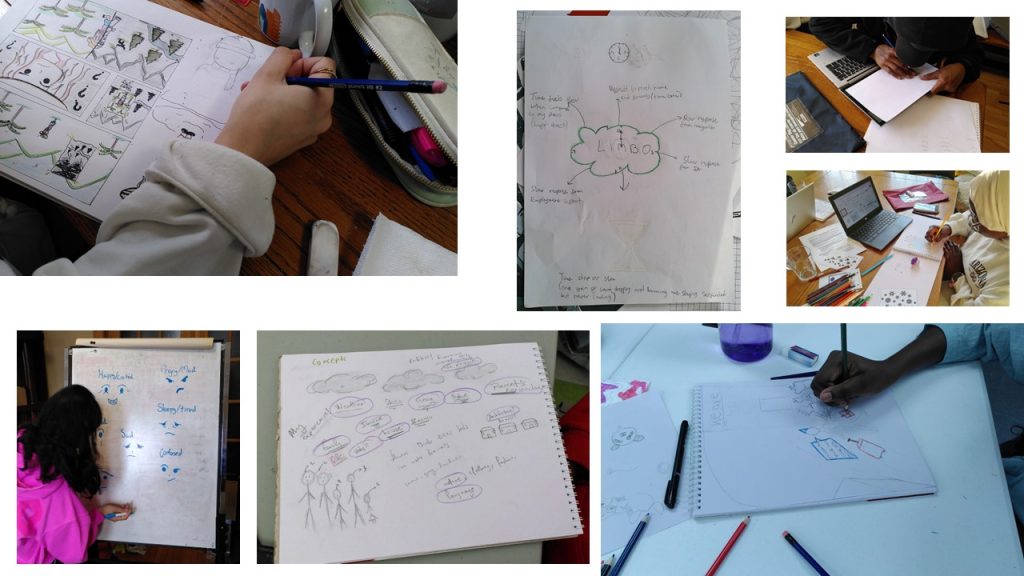
For comics workshops, we did a series of drawing warm up exercises at the beginning of each session. This helped participants get their minds into the now and occupy the space. Warm up exercises were followed by discussions on the FGDs themes that had emerged in February. From these discussions, every week we would work on different techniques and approaches to get to the stories that the youth wanted to convey through their drawings, cartoons and comics. Basic techniques and semiotic resources on comics were shared; a drawing kit and various materials were provided for them to work on their drawings during and beyond the workshops. As some youth knew how to draw very well, while others were less at ease and needed more help, the entire workshop programme involved ‘democratising’ and ‘demystifying’ the drawing process through taking care of the materials and approaches that were provided for the youth to occupy the space and feel confident and comfortable to meaningfully participate. This meant that in drawing, participant youth could draw from memory, by copying other works and making them theirs, or even by tracing and then refining images. By the end of the 6 weeks, each participant produced at least one comic, wrote a short description about the story the comics were conveying and also did short 2-minute videos so the stories of the comics could be heard directly from their voices. Some of these comics and stories have been published on our dedicated Youth Stories page! The comics will also be published as a collection in a comic book which will be shared on the GRABS website and presented at a future art exhibitions in September this year. Read on for more details below!
Photography and photovoice CPWs
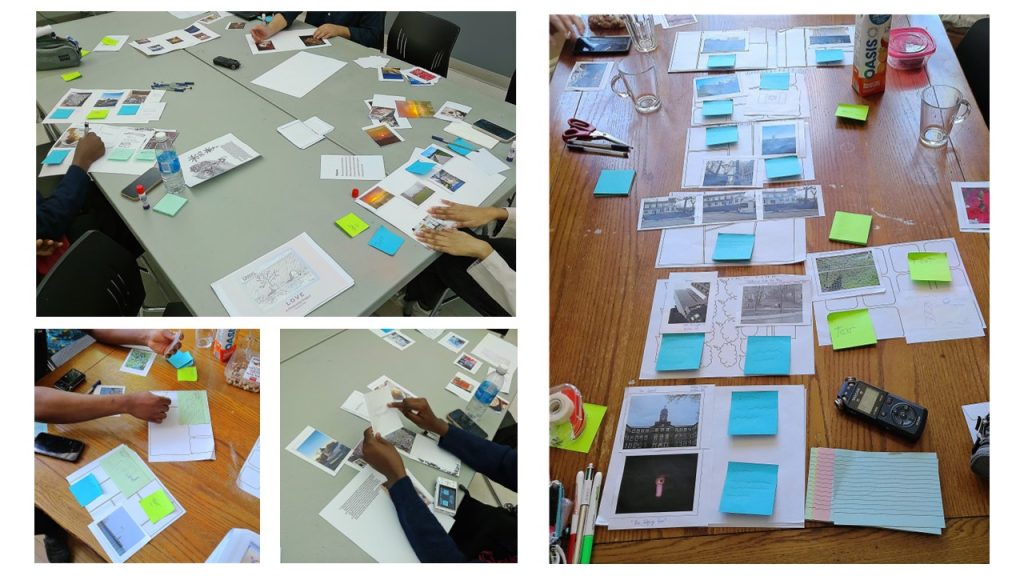
For the photography workshops, during the first couple of workshop sessions, participant youth discussed and decided on which themes they wanted to work on, they were given a digital camera and introduced to some basic skills in photography including notions on abstract, realistic and arranged portrait photographic compositions, and techniques such as light, lines, distance, movement, or the rule of thirds. Between each weekly session, participants were invited to take photos related to their chosen themes and bring them for discussion with the group. During these discussions, copies of the photographs were printed for participants to organise them according to the themes, while reflecting on their meaning, and the stories and feelings behind them.
The three CPWs on photography led to the production of 3x photobooks (2x at the HRC, 1x at the YMCA). The photobooks, as well as the collection of comics, will be soon published on the GRABS publications website, and also showcased at both HRC and YMCA venues as well as on art exhibitions in the future.
Podcast & soundscapes CPWs
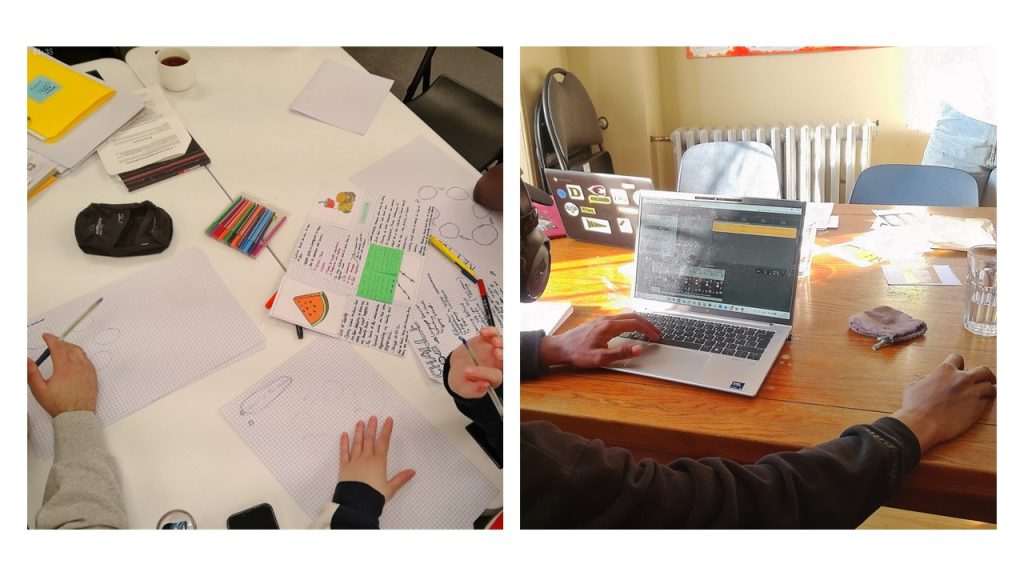
During the first sessions of the podcasts workshops, participants discussed and engaged with the FGDs themes to work out what story they wanted to tell through their podcasts. In the week session, the themes, formats, and roles for the scripts were brainstormed, while in week two they worked to outline the scripts with everyone’s intervention and voice. The following weeks were dedicated to the recordings, and finally the editing of the podcasts. In total, two podcasts’ episodes were produced by the youth (1x at the HRC, Episode 28, which focused on Cultural Shock Experiences of Living in Canada, and 1x at the YMCA, Episode 29, which addressed Stories of Arrival in Canada). Both episodes and many others can be listened to on the GRABS Podcast page and the dedicated Université Paris 8 SoundCloud Growing Up Across Borders album.
Mapping exercises
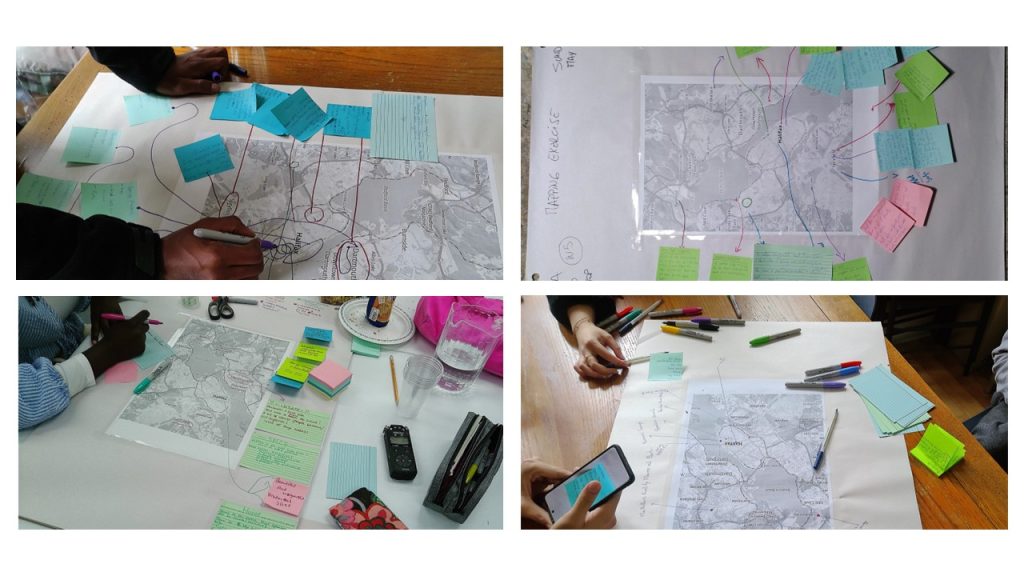
During the last sessions of each CPWs group, we carried out a mapping exercise to reflect on the spaces that youth encountered daily and how they experienced them. For this, I printed a large, black & white map of K’jipuktuk-Halifax downtown and surrounding areas, and invited participants to use post-its, cards and markers to write and/or draw over the map and reflect on those places where they felt safe or not, where they went for social and fun activities, where they found resources, friendships, and networks. The maps helped contextualise and deepen some of the experiences and stories that the youth had shared through their various comics, photos and podcast works, while also sharing new ones.
Thank you
My work and collaborations with the young people has been most insightful, humbling, and rewarding, even if at times it was intense and hard work due to the nature of the research, their often unfavourable and precarious situations, and the fact that it was not always easy to accommodate the project timings and expectations with their different priorities, commitments and availabilities. In effect, at the time I facilitated the CPWs, many participants were either working several informal jobs, preparing and taking school or college exams, taken charge of various family responsibilities, or even waiting for immigration hearings or news about their legal protection status.
In this sense, the support from both Halifax Refugee Clinic and YMCA Youth Outreach proved essential to first meet with the youth and create a rapport of trust and collaboration with the young people and then plan and accommodate as much as possible their realities, identify ideal times to use the venues for the workshops, and work around the organisations’ often urgent priorities and our research project expectations.
I am very grateful to Julie and Gill, and the entire legal and settlement teams at the HRC, and to Kathryn, Hayat and Saeed at the YMCA Youth Outreach team, who supported this research with comms, coordination, venues and resources to run the FGDs and the CPWs. I am also thankful to the staff at Saint Mary’s University, especially Prof Evie Tastsoglou, for her guidance and for hosting me as visiting research during this fieldwork.
I cannot express my gratitude enough to all the youth who participated and made this research possible and went on to produce amazing artworks, I want to thank by name:
Afia, April, Bible, Evanz, Fatime, Feza, Hekmat, Henry, Janet, Juanita, Kingsley, Noor, Pedro, Roda, Stella, Susan, Susana, & Vanessa.
Next steps
My next visit will take place in late September, early October, when we will carry out a series of art exhibitions and restitution events with the youth and academic colleagues, service providers and members of the community to share the work done by the youth, present and share about the GRABS project, and showcase the community work carried out by HRC and YMCA Youth Outreach.
Stay in touch to find out more!